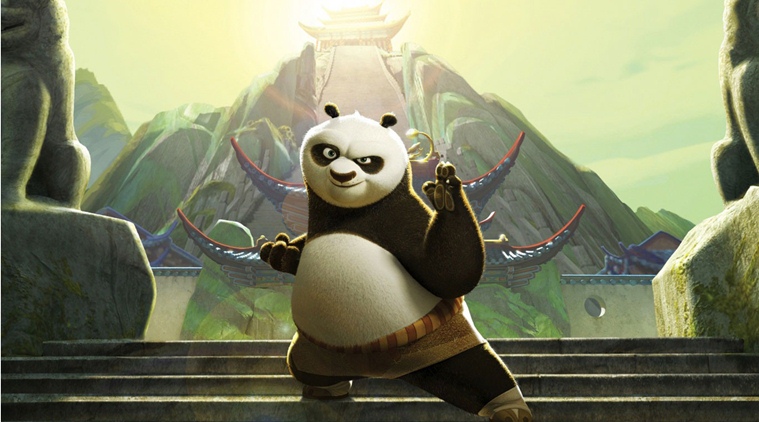
Kung Fu Panda is a terrific movie that relies on the standard form of old Martial Arts films from China and Hong Kong, especially those of Bruce Lee and Jackie Chan (who, incidentally, voices one of the characters). It also utilizes a lot of the tropes of sports movies, where the most common themes are discipline and self-improvement.
Trope: noun
a recurring theme or motif, as in literature or art
The adventure book uses the common trope of the damsel in distress.
Anthropomorphic: adjective
ascribing human form or attributes to a being or thing not human, like animals or inanimate objects
Children especially love anthropomorphic tales where talking animal friends have exciting adventures.
The story takes place in ancient China, and the characters are all anthropomorphic animals. We meet Po, a big, fat Panda who dreams of being a Kung Fu master. His room, like that of many boys, is filled with posters and action figures of his martial arts heroes, the Furious Five, who are tasked with protecting the peaceful valley where he lives.
But as he wakes, his dream is contrasted with his real life at the family’s noodle restaurant, a far cry from the adventure and romance he craves. His father is loving but unambitious, thinking that Po will one day take over the restaurant and learn of the secret ingredient that makes their noodles so delicious. This is Po’s Ordinary World.
In the meantime, up at the Jade Temple headquarters of the real Furious Five, there’s a disturbing revelation. Master Oogway, the spiritual leader, predicts that someone named Tai Lung will escape from prison. We don’t know who he is yet, but Master Oogway and his second in-command, Master Shifu, seem alarmed at the prospect. The fact that Tai Lung is currently in prison, should be enough to tell us that this character is probably The Shadow.
To defeat Tai Lung, Master Oogway declares that they must designate one great fighter as the Dragon Warrior, the Kung Fu master who is destined to defeat Tai Lung and maintain peace in the valley (gee, I wonder who that could be?). This is the Inciting Incident, the one event that kickstarts all of the action in the story.
The Jade Temple schedules an event, a ceremony where Master Oogway is to choose the next Dragon Warrior. Po is eager to attend and see his heroes in person and, through a sequence of comedic mishaps, Po finds himself in the center of the Jade Temple’s courtyard. Once there, Master Oogway names him as the Dragon Warrior.
Everyone else in attendance is astonished; surely this fat panda with the noodle cart can’t really be the guardian and protector of the valley? Yet Oogway remains steadfast: Po will be the Dragon Warrior. This is Po’s Call to Adventure.
Master Shifu and the Furious Five are unconvinced. Shifu vows to force Po to quit, thereby clearing the way for a member of the Five to become the Dragon Warrior.
Po’s path is now filled with obstacles, placed there by Shifu and the others. Faced with Po’s complete ineptitude, Shifu discourages him at every turn, and he’s repeatedly told by the others that he doesn’t belong. If Po is to realize his heroic destiny, he has a long and difficult path ahead of him, as all heroes do.

Elsewhere, we finally meet Tai Lung, a giant snow leopard guarded by a whole army of rhinos. The threat he poses is obvious by the means dedicated to keeping him imprisoned. It’s not enough – Tai Lung escapes anyway with an impressive display of ferocity and power. He sends word to the Jade Temple that he’s coming and expects to be recognized as the Dragon Warrior. At that moment, the conflict between Po and Tai Lung is made obvious – they both want the same thing, and only one can have it.
Upon hearing of the escape, Shifu reflects on his past. In a series of flashbacks, we discover that Tai Lung was once a pupil of Shifu’s and went on a rampage upon being denied the title of Dragon Warrior, only to be subdued by Master Oogway.
Back in the story’s present, Shifu informs Oogway of Tai Lung’s escape and reminds the master of his doubts regarding Po. Oogway urges Shifu to have faith in the panda and gracefully floats away with the cherry blossom leaves in the wind. His is a graceful death, and we have experienced the disappearance of the mentor.

Upon his return to the temple, Shifu finds Po raiding the pantry. The master is amazed by Po’s agility when climbing all over the room looking for food. It occurs to Shifu that he could use food to motivate his student.
With that, we arrive at a staple of sports movies: the training montage. Shifu teaches Po by tempting him with food, playing keepaway with delicious dumplings. The panda is forced to chase his teacher if he wants to eat. Po’s newly developed discipline is proved when he finally captures a dumpling but decides not to eat it.
Montage: noun
when a film assembles a series of shots and actions to compress a long process into a shorter period of time.
Lacking faith in Po and fearing what the consequences could be, the Furious Five decide to confront Tai Lung before he gets to the valley. They’re soundly defeated and returned to the temple.
In recognition of his development and maturity, Shifu gives Po the Dragon Scroll, the sacred document only the Dragon Warrior is allowed to read. Both of them are surprised to discover that it’s completely blank, only Po’s reflection staring back from the glossy paper.
He was counting on learning some deep secret on how to defeat his enemy. Lacking that, Po loses all confidence. What’s more, Shifu despairs upon seeing the Furious Five in defeat. Shifu decides to face Tai Lung himself. Po returns to the noodle restaurant and the Furious Five go to the village to supervise an evacuation of the villagers.
Po returns to the noodle restaurant to gather his family’s belongings and evacuate with the rest of the village. His father, sensing his son’s disappointment, decides to reveal to him the restaurant’s secret ingredient – nothing.
Po now understands why the Dragon Scroll was blank – just like his father’s secret ingredient, the key is to believe in yourself, which is the principle of the story. Po’s internal goal is to develop self-confidence; armed with that, he’s ready to achieve the external goal: achieving victory and saving the Peaceful Valley.
Tai Lung finally arrives at the Jade Temple which is where he encounters a newly-confident Po; the final showdown is here. The big cat is bemused to discover that the Dragon Warrior is a panda and engages in battle.
Po recognizes his obsession with the Dragon Scroll and fights by playing keepaway with it, as Shifu did with him. Tai Lung gets frustrated, not only because he can’t obtain the scroll, but also because none of his strikes can penetrate Po’s fat and cause any damage.
When Tai Lung finally gets his chance to see the Dragon Scroll, he can’t comprehend its meaning. He’s too self-centered and shallow to grasp anything that’s enigmatic. Po finally wins, the villain is defeated, the village is saved, and the Kung Fu Panda has fulfilled his potential and become the Dragon Warrior.
Kung Fu Panda is a fun riff on an established genre, using the form to express themes of teamwork, discipline, achievement, and developing belief in oneself. Po became his best self with hard work and sacrifice, a lesson we would all do well to remember.
 Adventure!
Leave a comment