
The events of stories are the skeleton of this book. The main text is about what happens. We’ll interrupt with a few special sections:
Characters: as we explore the different events in the journey, our hero will encounter other people. As we defined it earlier, the people in a book, movie, or tv show are called characters. We’ll put the discussion of characters, as well as examples of types of characters, in these green boxes.
Characters have functions in a story, and this book will try and help you to understand what they are. If you think of a story as a big machine, characters and other elements are the parts of the machine that make it go.
function: noun
the purpose or role that a person or an object fulfills or is suited for
The function of a firefighter is to put out fires.
- Characters in a story are really just parts of us. Each of us have the feelings and thoughts of the greatest heroes and the worst villains; who we become as we grow depends on the choices we make, and the inner voices that we listen to.
- Characters should be unique and realistic as people. Too often, bad movies and books make the characters flat, having no personality aside from their function in the story. Real people are more than the tasks we assign to them; they have thoughts and emotions. Recognizing those in a character also can help us to understand why they do what they do, and why they made certain choices in their life. To put it simply, realistic characters make stories better.
Occasionally, we’ll need to use some special words or terminology in order to provide better explanations. When we use a word you might never have heard or read before, we’ll define it in the blue boxes, which you’ve already seen.
Define: verb
to explain or state the meaning of
The teacher asked me to define the word ‘demolish’.

Ideas: any interesting discussion will usually raise some ideas that might be good for us to think about, or be good for their own conversation separate from the topic at hand.
We’ll share these ideas with you in these orange boxes. Consider chatting about them with your friends, classmates, or teachers.
Each section ends with a few questions that you may want to consider or discuss with your friends. Books like this can help, but you won’t really understand these ideas until you determine how you think and feel about them yourself. When you bring your own thoughts to the discussion is when you truly take ownership of what you learn, and it becomes part of you.
Discussions in classrooms and among friends sometimes involve different opinions and ideas. A discussion like this is called a debate. A debate is a great activity for expressing what you think and discovering the best available answer. When debating about stories, if you want to support an idea, you must refer to evidence, either in the form of the written words of a book, spoken words in a movie or tv show, or the actions of a character.
debate: noun, verb
a discussion between two people or groups who disagree on an important subject
The debate in Congress lasted two days.
evidence: noun
something that gives proof or a reason to believe
Scientists have not yet found evidence of life on Mars.
For instance, let’s take a trip back to America’s Old West for a moment.
Cal was looking forward to supper at Abbie’s place. It was a scorcher today, and the new bronco was proving hard to tame. Considering the day he had, the old cowboy was really looking forward to some fine lemonade.
The rusty door creaked as he entered, and Cal noticed that the room was empty, except for one other customer – Charlie Nightwell.
He hadn’t expected to ever see him again; last he heard, Charlie had left with a wagon train. His reputation as a crack shot would always guarantee him a job; his personality would guarantee that he’d never get re-hired.
“Howdy, Cal. Fancy seeing you here.”
“Nice to see you, Captain.”
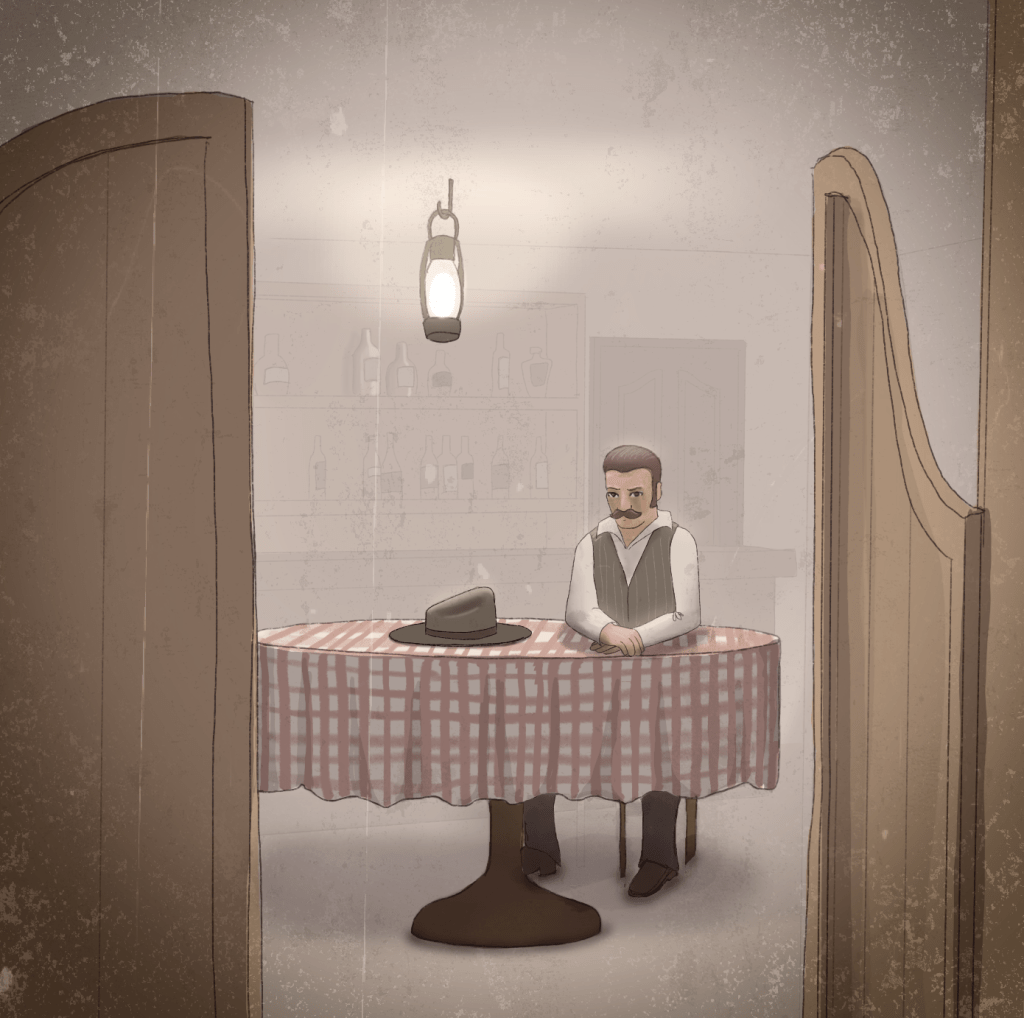
“No need for formalities, I didn’t re-enlist. Call me Charlie.”
“Where’s Abigail?”
“She went out back to fetch the chicken I ordered. Come on, have a seat.”
Darn, thought Cal. Not wanting to be rude, he pulled up a chair.
“I thought you were going west with the settlers.”
“I took them as far as I could.”
“How far was that?”
“Not far enough.”
He waited for him to say more, but Charlie didn’t.
“Captain, I thought they’d have made you a General by now, especially after Jackson’s Bluff.”
“You were there too, Cal. What did you think?”
“You were brave. It said so in all the papers.”
Charlie shifted in his seat, yawning as he did, though Cal’s old fighting instincts noticed that he had freed up his pistol hand.
“Well, my promotion got blocked. Apparently, someone talked to the Governor. They gave him what you could call an ‘alternate account’ of what happened.”
That’s it. That’s why he’s here, Cal thought, and he realized that it was only a matter of moments now.
As a reader, we try to infer the meaning of things when they aren’t spelled out in detail, but anything we conclude should come from the words of the story, which we call textual evidence.
infer: verb
to make a guess based on facts and observations; to conclude
I inferred from the books on his shelf that he enjoyed reading adventure stories.
Returning to this passage, there are two characters, Cal and Charlie. They know each other; apparently, they were in the army together.
Do they like each other?
They could be old friends, having fought aside one another in the army. One says “Howdy”, an old west way of saying ‘hello’, and the other says “Nice to see you, Captain”. These seem like affectionate greetings among old friends.
However, there’s evidence that they might dislike each other. When Charlie invites Cal to sit, Cal thinks Darn, a negative exclamation that means he’s not happy, and sits because he didn’t want to be rude. If you see someone you actually like, you sit with them because you want to sit with them, not to avoid being rude. Based on that, we can conclude that Cal, at least, dislikes Charlie.
Was it really a coincidence that they met?
Cal was surprised to see his old Captain at Abbie’s, we know that it’s so because we’re reading the account from his perspective; we hear his thoughts. Was Charlie surprised to see Cal? He said so – “Fancy seeing you here” is another way of expressing surprise at seeing his old acquaintance. We’re not hearing Charlie’s thoughts, though; he could be lying.
It’s not a sure thing, but consider this:
- The two men have a history. They don’t reveal enough for us to determine the nature of their friendship, but we do know that they experienced a battle together (Jackson’s Bluff).
- Charlie was hailed as a hero for his actions and was considered for a promotion.
- He didn’t get promoted, however, and Charlie thinks it’s because someone gave the Governor an ‘alternate account’ of his actions in battle.
- From Cal’s perspective, Charlie shifted in his chair to ‘free up his pistol hand’, and after the Captain’s failure to receive a promotion is mentioned, Cal seems convinced that’s the reason for the visit.
- Where’s Abbie? It’s her restaurant. Did Charlie send her away because of what he intended to do?
I think it’s fair to infer that Cal thinks that Charlie is here to confront him, and that Charlie thinks that Cal is behind the ‘alternate account’ that prevented his promotion.
Here are a couple of other questions to consider regarding this story:
- After Charlie told Cal to call him by his name, why did Cal continue to refer to him as Captain?
- What do you think happened next?
When discussing this or any other story, always return to the text to make inferences and arguments. In movies and TV shows, refer to the dialogue (what characters say) and action (what characters do). As you learn more about how movies and tv shows tell stories, you can also refer to visual evidence; filmmakers will express ideas or hint at truths with techniques such as lighting, composition, editing, or music. Often, this is how they tell you who the bad guy is.

Keep in mind that this book is full of spoilers. A spoiler is simply information about what happens in a story. We need to refer to the events and characters in stories in order to discuss the ideas of the hero’s journey. They’re called spoilers because if you haven’t read the story, the surprise of discovering what happens is spoiled, or ruined for you. For the purposes of the lessons contained in the book, it’s not important that you’ve read the story or seen the show we’ll be discussing, we’ll summarize what happens. But if you want to read the story or watch the movie and discover it for yourself, these are a few of the ones we’ll talk about in this book, among others:
- Harry Potter
- Frozen
- Ultraman
- Teenage Mutant Ninja Turtles
- Raya and the Last Dragon
- Lemony Snicket’s A Series of Unfortunate Events
- Mulan
- Spider-Man: Into the Spiderverse
- Stranger Things
- Coco
- Kung Fu Panda
- Amulet
- Moana
- Inside Out
- How to Train Your Dragon
With that final warning, we take our very first steps on our own journey. But first, let’s have a quick word about where it happens.


Leave a reply to Adventure! – Adventure! Cancel reply