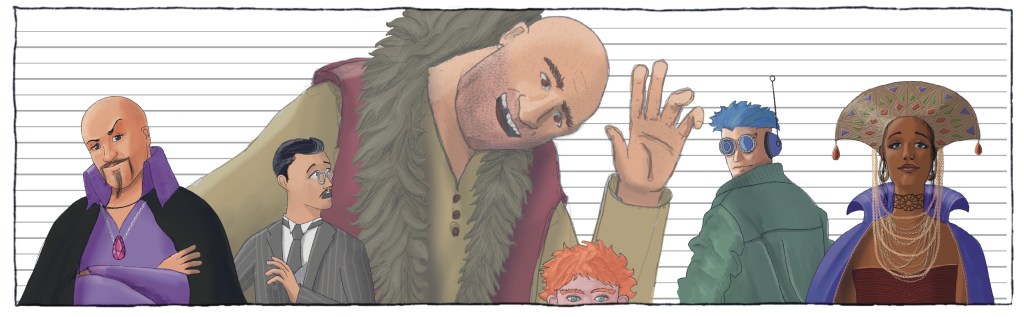
Now that a world has been built for the story, it has to be inhabited by characters, the people who live there. In the original text where he introduced The Hero’s Journey, Campbell said these myths were populated by characters he called archetypes, which are different kinds of people, each one representing something – feelings, thoughts, and ideas – inside of us. We all have the potential of becoming the greatest hero, the worst villain, and every type of character in every story; it all depends on the choices we make. We’ll just call them characters.
Later, we’ll cover the most common types of characters found in most adventure stories, including:
- The Hero, the character that undertakes the journey,
- The Mentor, the hero’s guide and teacher,
- The Shadow and The Villain, the characters that represent the forces opposing the hero,
- Enemies and Allies of the hero, people he meets along the way, and
- The Shapeshifter, kind of a wild card in the story.
In order for a story to really work, the characters should be believable, even in the most fantastical and alien environments. They should have thoughts and feelings that we recognize as real, and are motivated by things people really want, even if they’re wrong to want it.
When you meet a new character in a story, ask a few questions about them, such as:
- What do they want, and what would they do to get it? Is what they want something good for the world and other people, or something that will only benefit them alone?
- What are their values and principles? What do they think is right, or do they even believe in right and wrong?
- Are they honest? Do they tell others characters the truth about what they’re thinking and feeling, or do they deceive other peopleto get what they want?
- Their personality: are they personally kind and considerate of others, or mean and nasty to those around them? Are they shy and retiring, or are they an extrovert? Are they funny or always very serious? Are they happy or sad?
The people in stories, regardless of the environment they’re in, will want the same things as the rest of us: good things like their own personal well-being and that of their loved ones, safety from harm, or, for the more ambitious among us, wealth and power.
Static and Dynamic Characters
One thing that divides the characters you’ll meet is whether they’re static or dynamic. This defines whether the character changes at all. A static character doesn’t change, at least during the events we’re witness to. They are who they’ll be throughout the story, and their function in the story will likely stay the same as well. Most characters in serials, episodic stories like comic books or movie series such as James Bond, are static in nature.
A dynamic character, in contrast, will change in the story. How do they change? Usually they’ll learn and grow, becoming the best version of themselves (although there are some stories where characters become worse and change by surrendering themselves to their worst instincts). The hero in a traditional non- serialized story is a dynamic character by definition, but she doesn’t have to be the only dynamic character.
Prince Zuko of Avatar: The Last Airbender

An important moment in the growth of a child into young adulthood is when they learn to see their parents clearly as human beings, rather than just as the voice of authority. With most of us, we come to understand them better and, while they’ll always be our parents, our relationship transforms into a friendlier one (hopefully).
Not so with Prince Zuko, son of the Fire Lord. He spends the first half of the Avatar series looking for the approval of his abusive father, hoping to obtain it by capturing or killing Ang, the hero. Wanting the approval of a parent is a normal feeling; the parent being so horribly abusive and uncaring of his son is not.
Over time, with the patient guidance of his kindly mentor General Iroh, he comes to see things clearly, realizing that Ang is not his enemy, and that his father is to blame for all of the turmoil, not only in his life, but in the world as a whole. Prince Zuko’s transformation makes him a dynamic character, and is crucial to Ang’s success in defeating the Fire Lord and restoring peace.
- Think of people you know; do the characters in the stories you’ve read have anything in common with, say, your dad or your sister’s best friend? Do their personal beliefs end up manifesting themselves in their daily behavior or how they talk to others?
- The potential of every character in every story exists inside of you. Can you see bits of yourself in the characters in the books you read or movies you watch?
- Concerning the questions we ask about a character – what they want, what they would do to get it, their values and principles – have you though about asking those questions about yourself?
- Are you a static or dynamic character in your life? Are you changing, or do you always stay the same? Are you open to change in yourself, or do you resist? Does change frighten you?


Leave a comment