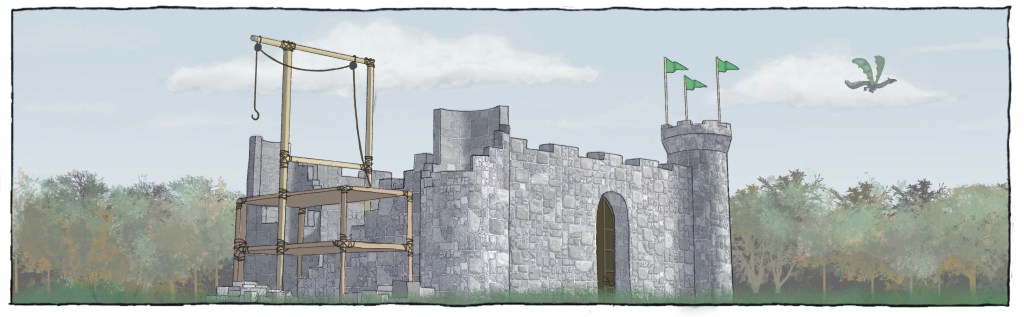
Some adventures take place in the world we live in, but stories also allow us to leave our normal life and go to an exotic land, one full of magic, places to explore, and things we don’t see every day. Stories in books are limited only by our imagination, and thanks to new computer techniques, movies are catching up. We can go anywhere in the world, and even out of it.
exotic: adjective
From a foreign place, or very unusual or interesting
The zoo in Chicago has very exotic birds from South America.
A term has been coined by people who make places for books, movies, and videogames: ‘worldbuilding’. It’s a great word, one that does a good job of describing what writers and artists do. They do the hard (but fun) work of designing a place for their story, and then set our hero free to wander around in it.
In most adventure stories, the setting can be divided into a few kinds:
The world we live in now. Many stories don’t build a place for their stories but set them right here. Most superhero stories take place in our existing world, the only real difference being the presence of the superheroes themselves. By setting their stories here, superhero comics make it easy to imagine ourselves in the role of the hero.
A secret world. Another place where stories are set is in a hidden world beneath ours. The magical world that Harry Potter inhabits is one such place (aside from dismal summers with the Dursleys), or the land of Aleddia that Emily discovers in the Amulet graphic novels. Stories set in places like these will usually have a chapter where our hero discovers this secret world and has to learn the rules of it. Often there will be a character, such as Hagrid, who acts as a guide for our hero in this secret world.
Historical eras, real or imagined. History is fertile ground for inspiration. Studying the past is a big creative resource for writers, one in which they can take creative liberties. Fantasy worlds such as the ones in Lord of the Rings or Frozen are set in an imagined history – not a real place, but one that borrows heavily from European history and culture (Kung Fu Panda and Raya and the Last Dragon did the same but borrowed from Asian history instead).

The author Arthur C. Clarke was quoted as saying that any sufficiently advanced technology was indistinguishable from magic.
Future worlds. Science Fiction uses technology in the future, where machines allow us to do things akin to magic, such as travelling in space across vast distances, meeting alien life on other planets, driving flying cars or using futuristic weapons.
That’s why, in many SciFi stories, technology is used like magic in fantasy stories. Instead of a magic wand that shoots beams or a winged horse, a future world would have a laser gun or a flying car. They’re different, but these objects have the same function as their fantasy counterparts.
Science fiction is still trending in Japan, especially when they involve giant robots. Though the Transformers movies are produced in Hollywood, the original toys came from Japan, and anime such as Gundam and Macross are still very popular.
The most popular forms for stories among kids in Japan are anime, their word for animated shows and movies, and manga, which are comic books.
Dystopia is a word that refers to imagined places that are terrible, where the people are miserable and usually subject to an oppressive ruler or political system. The purpose of dystopian fiction is to show how our livescould be if we, as a society, make the wrong choices or allow our worst notions to control us.
Probably the greatest dystopian novel is George Orwell’s 1984, but readers of a younger age might be more familiar with the sadistic rulers of Panem in The Hunger Games.
Exposition: Introduction to a New World
Like our own, each world has its own rules, and we have to learn them twice. The first time when we’re introduced to it in the beginning of the story, we (the readers / viewers) need to be shown how the world works so we know how people interact and navigate in this special place. The word for explaining things to the reader in a story is exposition. It’s one of the hardest things for a writer to do in a way that’s elegant and clear, so there are some tricks stories use to do it.
In How to Train Your Dragon, the hero, Hiccup, is given the narrator’s voice – a narrator is someone who speaks directly to the viewer or the reader without speaking to other characters. As we look at the Viking village on the islands he calls home, Hiccup explains:
“This is Berk. It’s twelve days north of hopeless and a few degrees south of freezing to death. It’s located solidly on the Meridian of Misery. My village [is] in a word, sturdy. It’s been here for seven generations, but every single building is new. We have fishing, hunting, and a charming view of the sunsets. The only problems are the pests. You see, most places have mice or mosquitoes; we have dragons.”
(Written by William Davies, Dean DeBlois, and Chris Sanders. Adapted from the book by Cressida Cowell)
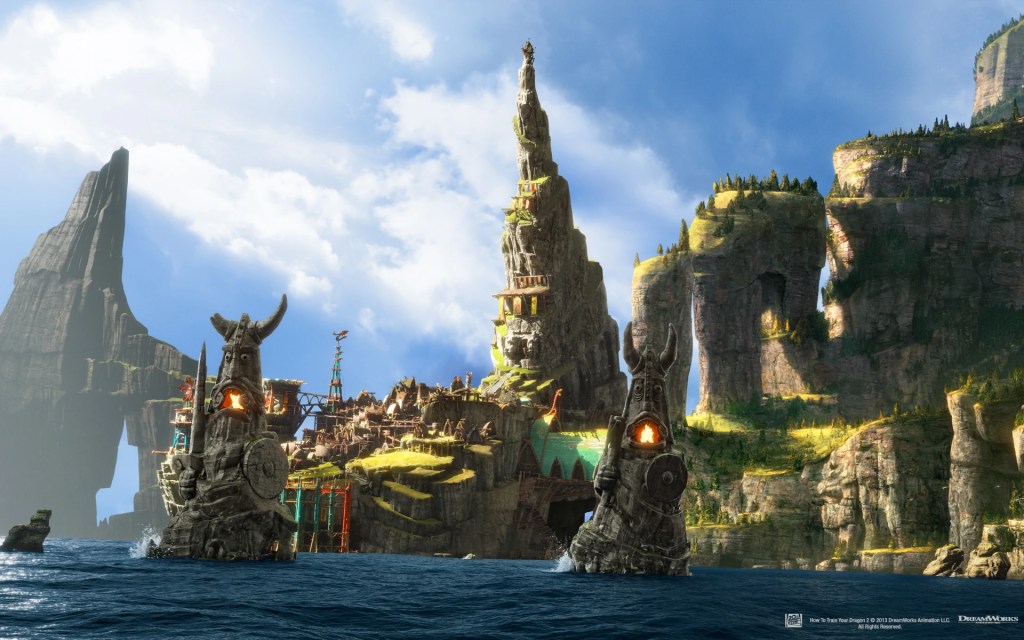
In movies, exposition is handled with a combination of picture and spoken word. While Hiccup speaks about his village, the images show us an ancient settlement on an island; this is how we know he doesn’t live in a big city in the modern day. Hiccup continues to explain how they survive and fight the dragons, and in a combination of dialogue and narration, it’s explained that Hiccup himself is kind of wimpy, a disappointment as a fighter. We now know where the story is set, how it works, and our hero’s place in it.
The second time the world is explained is when the hero goes on her special journey. She leaves her comfortable life to go to a strange new part of the world, one full of danger that she and her friends must avoid or overcome. Then it’s her turn to learn how this place works so she can traverse it safely, and we learn about it too by tagging along. In many cases, the hero is coupled with a guide, a character whose job it is to explain this new world for her. This is especially important in ‘secret world” stories, where the hero needs to quickly learn about a world she never knew existed. Some examples of heroes and their guides:
- In Amulet, Emily and her brother Naivin find themselves in a secret world where they have to rescue their mother. They actually have two guides: first, they find their long-lost great- grandfather, who tells them about the secret world of Alledia on his deathbed, and after he dies, they’re assisted by the robots he built, especially one named Miskit.
- In the Harry Potter series, Harry is first made aware of the secret magical world when Hagrid comes for him. On the night they talk, Hagrid explains everything he, and we, need to know about this world hidden beneath ours, including why it’s a secret, the existence of the Hogwarts school for magical education, and the special relationship Harry has with Voldemort, the evil sorcerer who’s a threat to everyone in the magical world.
- Later, Hagrid accompanies Harry to Diagon Alley, the first time the boy sees the magical world for himself. He comes to understand the norms and cultures of this world firsthand, keeping quiet to avoid revealing his lack of understanding. In this way, Harry is really our representative, and is no different from us if we had been placed in his shoes.
Remember, the way an imaginary world is described in a book or shown on screen can be dazzling to us, but for the characters who live there, it’s just their everyday life. By now, they’re bored by the giant dragons, conjuring wizards, and faster-than-light spaceships. In the stories you read and watch, notice how the characters pay little or no attention to the things that would amaze us if we could visit.
- Is our world really any less amazing than the ones we read about? Or do we fail to be amazed because we live here every day?
- Remember, Mr. Weasley, the dad of Harry Potter’s best friend, was enchanted by the muggle world, as he called it. So was Ariel, the main character in The Little Mermaid. Try to look at things anew. What would your favorite characters from other worlds be amazed by if they could visit you?
- What about you? Have you ever daydreamed about your own imaginary world (perhaps when you should have been doing homework)? Think like a storyteller:
- What did the world look like? Was it mostly cities, countryside, or a mixture of both?
- Who ruled this world? Did they govern fairly or were they demanding overlords?
- Who lived there? Were they mostly farmers, merchants, soldiers, or something else?
- What were the rules of this world? How did it work? What kinds of things did its inhabitants have to do to live?
- Who prospered in this world? Who suffered?
These are the kinds of questions that writers and other kinds of storytellers have to ask themselves when worldbuilding. They need to know the answers to these questions so they know how their characters should behave when navigating this world.


Leave a Reply