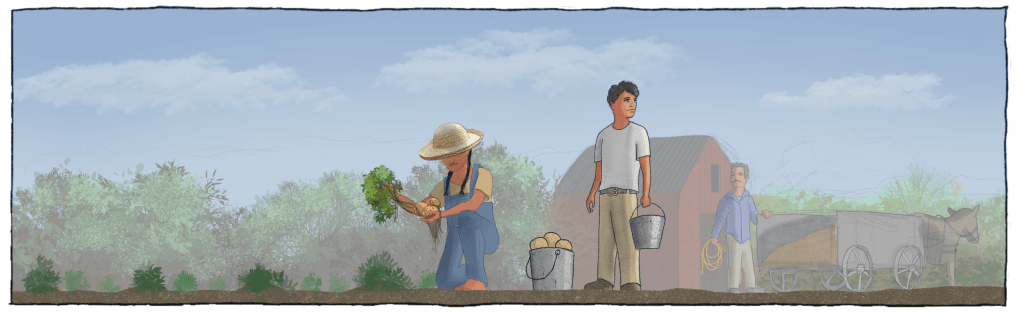
Stories really begin in the Ordinary World. Everything is normal, nothing unusual for the people we meet at the beginning. Characters are engaging in their regular day, life is static. To understand these beginnings, and all other stages of the story, we must first meet our Hero.
static: adjective
Without motion or change
The town center was static for years until new shops and restaurants opened.
Characters: The Hero
Heroes are the main characters in stories. They’re the people who undertake the journey for us, and it’s through their eyes that we experience the events of the story. Heroes come in all shapes and sizes. Don’t be tricked into thinking that all heroes should be the tall, muscular man common to comic books. Any kind of person can be a hero, as long as they have the qualities like courage, intelligence, and generosity that we look for in our heroes.
Like all characters, we want them to be believable as people. What they think and how they feel should be relatable, meaning that we can understand their thoughts and feelings, because we’ve thought and felt that way ourselves.
Not that all of their thoughts are good ones. We all have bad thoughts sometimes, and negative feelings like anger, selfishness, and a desire for revenge. Those are feelings that dominate the thoughts of the villains we’ll meet. Whether we become a good person or a bad person is determined by which ones we act on. The hero may falter sometimes, but in the end, she resists bad thoughts and relies on her sense of decency to guide her.
Here are the things that make a character the hero of their story:
- First, she receives the Call to Adventure, the prompt that forces her to leave her normal life and embark on a journey to save the world and fight for good. She may hesitate to leave her home at first, she may not even want to go. The Italian writer Umberto Eco once said that “The real hero is always a hero by mistake; he dreams of being an honest coward like everybody else.” In spite of that, she ultimately makes the decision to answer the call and take the journey.
- Once on the journey, she encounters obstacles blocking her path, including opposing characters who try to impede her progress, or even kill her. The hero fights through those obstacles until the end.
- She may have friends or allies helping her, but at the most important parts of the journey, she fights alone, relying only on what she’s learned and the skills she possesses. This is why heroes are often orphans, not having parents who can offer help through difficult times. In a story, we want to see the hero overcome hardships on her own.
- Though it may appear that she’s fighting only for selfish reasons, by the end it becomes apparent that she’s fighting for a principle she believes in. She comes to believe in this principle so much that she’ll ultimately sacrifice herself for it.
- This journey she takes will be the most important event of her life. It will change her forever, and her life will be different (usually better) than it would have been if she hadn’t ever left home.
These are things that heroes of most stories have in common. We’ll revisit the hero’s progress through the journey, as we discuss other events or meet other characters.
We first meet the hero in his life as he’s lived it for as long as he remembers, probably since he was born. He’s safe and secure in his everyday existence, but there’s something wrong, either in the world around him or in his feelings inside (probably both). He’s dissatisfied with life, and there’s something both in his world and inside of him he has to fix. The journey ahead may be full of travels and adventure in faraway lands, involving strange characters and creatures, but the real reason for the journey is to fix the flaw in themselves.
Let’s meet a few heroes in their ordinary worlds:
- Harry Potter is living miserably with the Dursleys, his dreadful aunt and uncle and their monstrous brat of a son, Dudley. He’s yet unaware of the challenges and dangers that await him; right now his biggest concern is surviving the minefield of a terrible home life.
- Po, the title character of Kung Fu Panda, is unhappy waiting tables at his father’s noodle shop, and isn’t thrilled with the prospect of inheriting the restaurant someday. He dreams of being a great warrior, but that dream seems impossible.
- In the Netflix show Stranger Things, Mike lives a generally happy life with good friends, playing adventure games like Dungeons and Dragons in his basement. His life is unremarkable, though, and like all boys, he dreams of living a life that’s truly adventurous.
Though the hero’s life seems stable, that’s only an illusion. Whatever he thinks, his situation can’t continue forever. There’s something wrong in his life, and there’s an event coming soon that’ll blow it all to smithereens. He’ll soon be forced to make a decision, one that will determine the course of the rest of his life.
The Inciting Incident
An event occurs (as events do); it could be something big, it could be appear to be inconsequential, but whether he knows it or not, it’s the most important occurrence of the hero’s life so far.
inconsequential: adjective
of little or no consequence; unimportant
Making an error in practice may be inconsequential, but making one during competition can destroy one’s chances of winning.
Something happens, and to an astute observer, it’s a clue that their life as they know it is about to change. Screenwriters call this event the Inciting Incident. It happens, and it’s a signal that something is in motion, the first in a series of events that the hero has no control of.
You should note that the importance of the inciting incident isn’t always clear to the hero; sometimes it’s interpreted as having no importance at all. Consider the example of Miles Morales, the new Spider-Man. While on an excursion with his uncle, he notices a spider that’s bitten him on his hand. Thinking nothing of it, he swats the spider and brushes it away.
Those of us familiar with the original Spider-Man Origin Story know better; that was no ordinary bug bite. It was from a radioactive spider, and though he doesn’t know it yet, it’s given Miles incredible superpowers that’ll propel him headlong into a life of action and danger.

Comic books and superhero movies usually begin with an Origin Story, telling us how the superhero came to be so super.
We’ll examine the special rules of superhero Origin Stories later in the book.
Some other Inciting Incidents:
- In Frozen, the parents of the two sisters die tragically in a shipwreck. Since they were royalty, this means that the older sister, Elsa, will have to emerge from confinement to be crowned Queen. She’s frightened that she’ll be unable to control the magical abilities she’s been concealing.
- In Mulan, an invasion by the Huns causes the Emperor to conscript one man from each family into the army to defend China. When the Emperor’s Counsel comes to town, Mulan is distraught to realize that means her father, who is far too old for war.
Whether the hero has figured it out or not, the inciting incident has changed his world forever, but it only really becomes clear to him when he gets the Call to Adventure.
The Call to Adventure
At some point, the world sends a message to the hero. It tells him that the life as he knew it is over. It tells him that his entire world is in danger, and that he alone can save it. It tells him that he has to leave his life of comfort and go forth on a journey, into the unknown, and risk losing everything. If the Inciting Incident hadn’t made it clear, it’s undeniable now: mortal peril awaits. This is the Call to Adventure, the true beginning of his journey.
The Call isn’t necessarily an actual spoken warning, it doesn’t have to be someone saying something (though it could be). It’s simply an event that makes it clear to the hero that he no longer has a choice – he learns of a threat that could destroy him or his world, and that he alone can stop it.
He may refuse at first, thinking that it might not be that serious. He might not recognize that he’s being threatened with utter destruction. He may want the whole problem to just go away and leave him in peace, but he comes to understand that inaction is not an option. He must act, or face certain doom.
Regarding the Call, the hero must decide to go. He can’t find himself in the midst of the journey because he was abducted or forced into it. He must have an understanding of the situation he’s faced with and make a deliberate choice to go forth into the unknown.
The Three Goals of the Hero
At this point, the hero is given the mission that’s central to the story. This mission has three parts, which we’ll refer to as the Three Goals:
- There’s an External Goal, a strategic objective that he must reach in order to achieve victory over The Shadow (the evil forces that oppose him).
- There’s also the Internal Goal, something inside of him that he needs to fix.
- Related to both is the Principle, the ideals and beliefs that he’s really fighting for.
In many ways, the Three Goals are at the heart of what motivates the hero, and what keep him moving forward. The Three Goals are why the hero sets foot on the path in the first place, and the Principle, if we share the hero’s values, is why we should care if he succeeds.
What is the call that forces our hero onto the road?
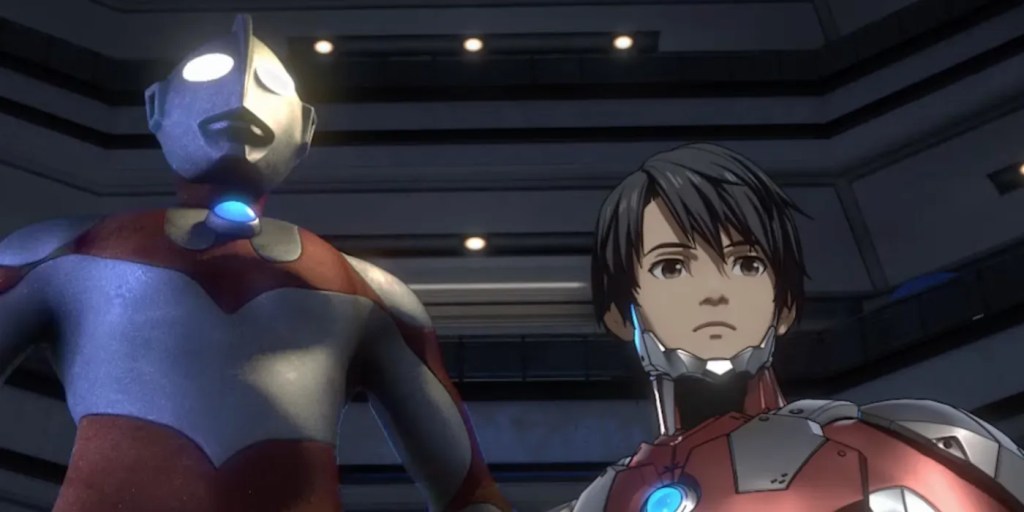
- In Ultraman, Shinjiro (son of the first Ultraman), has been skeptical about the need for a new Ultraman, and doubts the claims of Morabushi, his commanding officer. He responds to a call in downtown Tokyo and meets his first alien invader, interrupting a powerful being while it devours some unfortunate people. Only now does he see that the threat is real, and he accepts the call: “I know what the world needs me to be, and that’s Ultraman.” His external goal, of course, is to protect the citizens of Tokyo from being eaten by hungry aliens. His internal goal is to overcome his continuing doubts about his purpose.
- Moana is a Polynesian princess charged with protecting the people of her island community. As a very young girl, the ocean – a magical character in the story – chooses her to restore peace and prosperity by returning a magic gem to the goddess Te Fiti from whom it was stolen. She forgets the incident, but when her island’s crops begin to fail, her Grandmother reminds her of it – “The ocean chose you.” She is tasked with being the first of her generation to resume the sailing traditions of her ancestors and find the goddess.
Raya of Raya and the Last Dragon
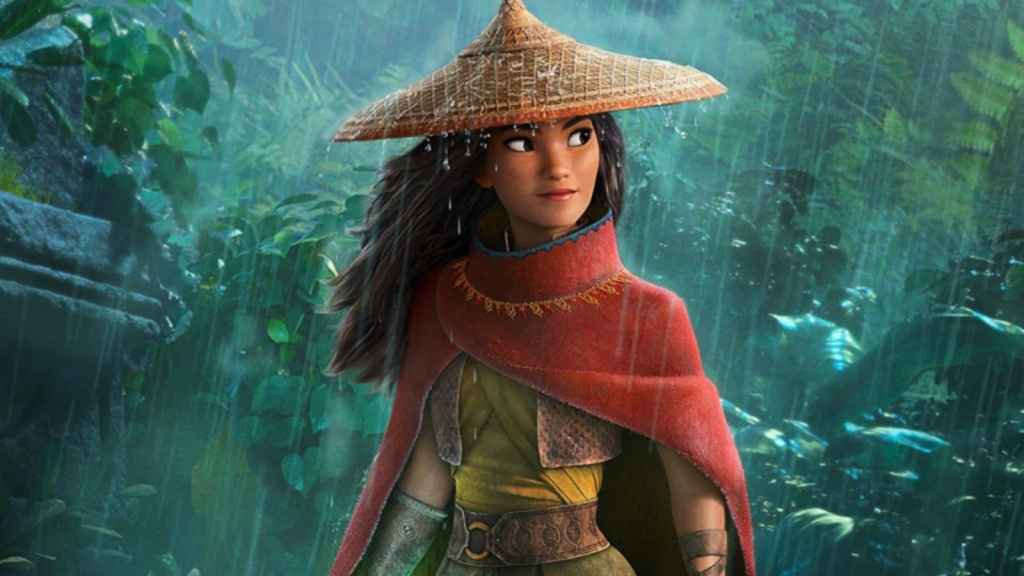
Raya is a good example of a character who fits the model of a hero; the first clue is that the movie is named after her. It’s a historical fantasy, meaning it takes place in the past, but not a real history. Like the settings in many other stories we’ll talk about, Raya’s Kumandra is an imaginary place, but has some elements of real- world culture. She’s a hero because the story follows her journey.
A prologue reveals that long ago, the land of Kumandra had been split by into six warring factions by the Druun, an evil force that infects the land and has the power to petrify people (turn them into stone). A magic gem has the power of resisting the Druun, and could possibly revive the dragons who once protected the people of Kumandra.
The story begins as Raya’s father teaches her the fighting skills she needs as part of the elite unit charged with protecting the gem. His dream is to use it to revive the dragons and reunite the six lands, restoring peace and trust among the people. This is Raya’s Ordinary World, the place she’s lived since she was born, and the situation in the world she knows.
At a summit with the leaders of the six lands, Raya is betrayed by a rival, who attempts to steal the gem. In the struggle, the gem is shattered into six pieces, each piece seized by a character from a different country. This is the Inciting Incident, the event that sets the story in motion.
Broken, the gem’s power is diminished and the Druun advance, unopposed. Raya’s father gives his daughter their piece of the gem and urges her to fix it and find Sisu, rumored to be the last surviving dragon who can save them. He’s then petrified by the Druun, sacrificing himself to save Raya. She’s been given a mission; this is her Call to Adventure.
To this point, Raya has met all the qualifications of the hero in a story:
- We meet her in the Ordinary World, a world that’s imperfect and needs to be fixed. The Druun are running roughshod over the land, people who should be friends are fighting each other, many of their loved ones have been petrified and need to be revived, and their traditional protectors, the dragons, are absent.
- She is alone, not having the assistance of a protective and helpful parent for most of the journey.
- She receives the Call to Adventure and has been given a mission with an external goal, restoring the magic gem and locating the Last Dragon.
- A principle has also been introduced: that trust between the warring factions of Kumandra can save the world if she believes in it, which she doesn’t (yet). Overcoming the mistrust and reluctance inside of her is the internal goal.
We’re still early in our quest to understand the Hero’s Journey, but later events also confirm that Raya is an excellent hero:
- She meets the Mentor (spoiler: it’s the dragon) who guides her, not only in achieving her goals, but also in understanding the principles they represent;
- She overcomes obstacles and enemies, and makes friends and allies along the way;
- The mentor is removed at a crucial moment, leaving Raya to face the showdown alone;
- Raya ultimately comes to understand what her father had been trying to teach her, and sacrifices herself for the principle that represents everything she believes in.
Remember that, no matter how epic or fantastic, the events of the adventures we read and watch are related to our own experiences, and we can use stories to help us reflect on our own lives. Think of yourself as the hero in your own story.
- Where are you in your story? Are you still in your Ordinary World, or have you set foot on the path already?
- Have you received your Call to Adventure yet? It could be a real opportunity for you – how did you respond?
- What are your Three Goals? Really ask yourself these questions.
- What is your external goal? What is it you want to achieve in life?
- How will your journey change you into a better person? That would be your internal goal.
- What principles are important to you? How will your journey strengthen those principles in your life?
These questions aren’t just for heroes in a fantasy world, they’re for you too.
Meeting with the Mentor
Usually by the time the hero receives the Call to Adventure, we’ve met all the important characters; they’ve either appeared in person, or they’ve at least been mentioned. One of the most important is The Mentor. We meet the mentor fairly early in the story, and he undertakes the role of teacher or guide for the hero.
The Mentor is someone wise, who tells the hero what he needs to know in order to survive the hardships he’s about to experience. Given what the mentor knows, it’s possible that he was once the hero of his own journey when he was younger.
But in this story, the mentor’s function is to use the knowledge he’s gained to teach the hero, and sometimes to urge him to undertake the journey in the first place. The mentor is key; it’s unlikely the hero would succeed in their quest without the teachings or tools the mentor provides.
Some of the advice the mentor might provide include:
- Illustrating the danger the hero is facing,
- Encouraging the hero to take the journey, telling him how to proceed, and providing other advice along the way,
- Reminders of the principles at stake, and what they’re truly fighting for.
It’s crucial that the mentor not be too active in the story. His job is to teach the hero, and it’s the hero who must ultimately take the journey and overcome all of the obstacles on the road.
Critically, as we’ll learn later, the mentor must be absent when the hero takes the final steps of the journey. The mentor must be far away, imprisoned, or he might even have died. The important thing is that the hero stands alone in the end, using what he’s learned from the mentor to achieve victory himself.
Some examples of the mentor include:
- Gandalf in Lord of the Rings, Obi-Wan in Star Wars, and Dumbledore in the Harry Potter books are the characters we usually think of when it comes to mentors: old, wise, and full of experience.
- In the cartoon series Avatar: The Last Airbender, the writers did something interesting with the mentor. General Iroh starts out the story as the mentor of Prince Zuko, a sworn enemy of the hero, Ang. But because of the General’s patient and wise guidance, Zuko grows and changes, ultimately becoming an ally to Ang. The General assumes the role of mentor to the entire group of heroes who fight to save the land from the evil rulers of the Fire Nation.
Albus Dumbledore of the Harry Potter Books and Movies
In some ways, Dumbledore is a perfect example of the traditional mentor. He is old and exudes wisdom. He is the headmaster and professor at a school, and a teacher’s entire purpose is to mentor the young students in his care.
Though Harry has many adults who help to guide him on his journey, when considering his role in the entire book and movie series, Dumbledore is the true mentor. Consider:
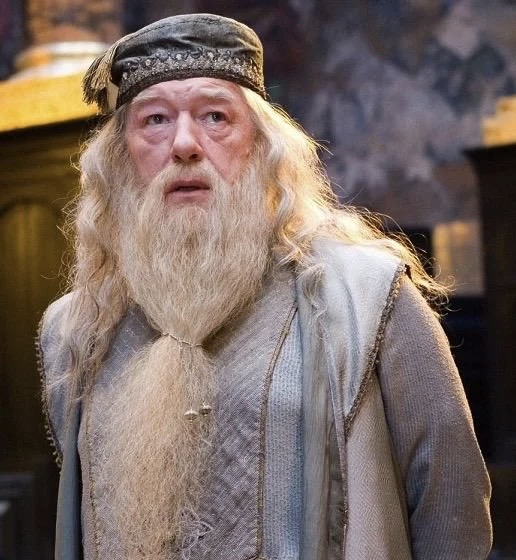
- First and most importantly, Dumbledore is the one who tells Harry that it’s his purpose to rid the world of the evil Lord Voldemort, and that only Harry can do it.
- To help him along the way, Dumbledore ensures that Harry has all of the knowledge he needs to achieve his goal, either by appointing teachers to hone his magical skills, or by exploring ‘he- who-shall-not-be-named’s’ life story in order to show the boy where Voldemort might be vulnerable.
- Dumbledore gives Harry some tools to help him as well, most notably the invisibility cloak that once belonged to his father.
- Like all mentors, he teaches the hero everything he needs to know, and then he leaves to allow Harry to use what he’s learned to defeat Voldemort by himself. This is crucial – the mentor’s job, as we learned, is to teach the hero what he needs for the journey, not to take the journey himself.
Sometimes popular culture will promote a certain type of person in a certain role. Just as the hero doesn’t have to look like Superman or Neo of The Matrix to be a hero, the mentor doesn’t have to look like the old man with the long, flowing white beard to be the mentor; he (or she) just has to be wise, patient, and unselfish. They can look like anyone, they can be men or women, and in stories like Teenage Mutant Ninja Turtles, the mentor isn’t even a human being.
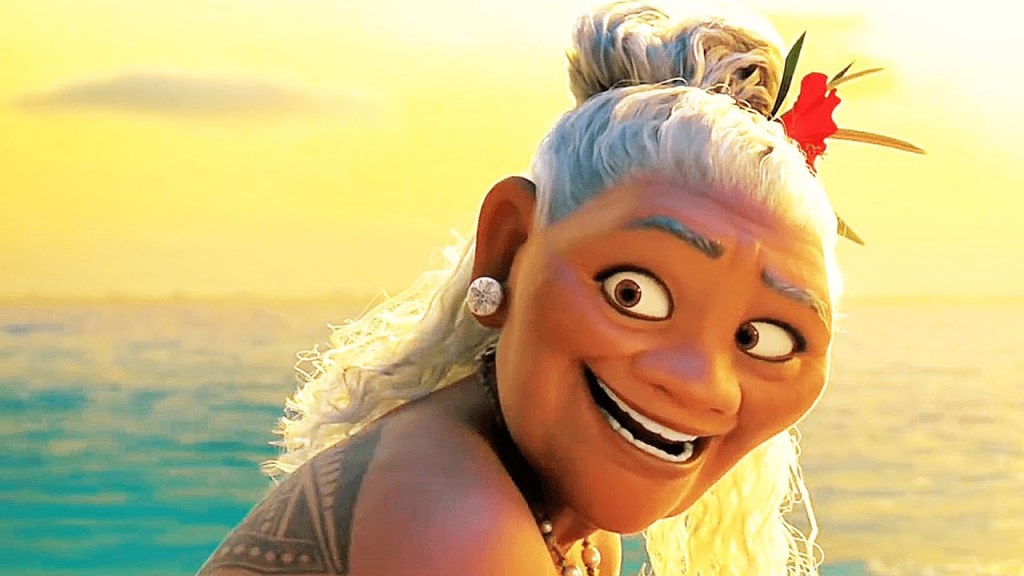
Gramma Tala in Moana
Moana is a young girl; the magic of the ocean has chosen her for a great mission: sail the sea to find Maui, a demigod who stole the Heart of Te Fiti, the goddess who made the islands of Polynesia. Doing this will save her island community.
Unfortunately, her dad won’t let her go. It is Moana’s grandmother, Gramma Tala, who encourages the girl to realize her destiny. She shows her granddaughter the great sailing history of her people, the history that her father has forgotten. When the island begins to die, Gramma Tala gives the girl the Heart of Te Fiti, the gem that gives life to the goddess, and tells her to “Go. The ocean chose you.” This is Moana’s Call to Adventure.
- Who are the most active mentors in your life? What advice or guidance have you received from them? Have they encouraged you to start your own hero’s journey?
- Most mentors were heroes of their own adventures when they were younger. Ask your mentors about their hero’s journey, and how they came to learn what they’re teaching you.
Thresholds
The hero will meet resistance throughout the story, but there are key points along the way where he’s required to re-commit to his decision to move forward. These points are called Thresholds. Each threshold increases the danger for the hero.
Having seen the danger, weighed the costs of inaction, learned what he could from the mentor, and conducted his preparations (or not), the hero sets forth on his journey, leaving his Ordinary World, and there’s no turning back.
He meets resistance right away.
threshold: noun
an architectural term that means the piece underneath a door at the bottom of the doorway. You cross a threshold when you pass from one room into another, for example.
But in the context of a story, rather than passing from room to room, it means passing either into new lands, or from one part of a story into another.
In choosing to enter the enemy kingdom, the knight crossed a threshold that would lead to war and change his life forever.
This is the First Threshold, when the hero takes his first steps into the unknown, and it’s usually the first action scene in an action-adventure movie. What stands in his way? Whatever or whomever it is, we call this first obstacle the Threshold Guardian.
Threshold Guardians are characters or things that try to prevent the hero from advancing; we meet them or their kind several times in each story. They could be characters, sometimes the allies of the main villain (we’ll meet him later), but not always. They could be bad guys who attack the hero for their own interests; maybe they’re robbers.
The hero must defeat them, or devise a way past them if he’s to advance. If these are characters that are allied with the main villain, often the hero will find a way past them without yet defeating or killing them. Usually, this particular guardian will return throughout the story.
Sometimes the first threshold isn’t even a character at all, but an obstacle of another kind, perhaps an imposing mountain or a desert that is thought to be impassable. The point of the first threshold is to give the hero an obstacle to overcome, illustrating that:
- He is fully committed to the journey, and
- The incident displays the skills and acumen (or lack thereof) that the hero currently possesses. Now we know who he is relative to the task he faces.
When we mention that Threshold Guardians are characters or elements that stand in the way of our heroes, the first thing that comes to mind is that they are enemies. Sometimes that’s true; consider Draco Malfoy, Harry Potter’s nemesis at school. Having established himself on day one as a rival, and a hostile one at that, Malfoy does everything he can to make Harry’s life difficult, and to foil any plans he and his friends Ron and Hermione may have. At every step, Potter has to consider Malfoy and what he might do to interfere.
However, you mustn’t think that all Threshold Guardians are enemies; in most animated films where the hero is a child or an adolescent (and not an orphan), the parents are almost always attempting to stop their children from embarking on the adventure. Consider:
- In Moana, her father the chief had a traumatic experience as a youth that caused him to forbid any travel off the island. Moana knows this to be a strategy for failure, so she has to defy him in order to take to the sea and save the island.
- In How to Train Your Dragon, our hero Hiccup is the wimpy kid who first dreams of pleasing his father by becoming a great warrior. But when he befriends a dragon, his father, the great dragon-slayer, becomes an obstacle. Hiccup’s friendship with the dragon has to be concealed from his father and the rest of the village, for fear that they won’t understand and will attack his new friend.
A parent’s job is to keep their children safe, and here in the real world, the smart thing is to listen to them. But in the special circumstances of the movies, the hero is constantly having to sidestep their parents in order to save the world.
Examples:
- In the first Lord of the Rings movie, The Fellowship of the Ring, as the hero Frodo sets out on his Journey, his best friend Sam hesitates and says “This is it. If I take one more step, it’ll be the farthest away from home I’ve ever been.” This spells it out clearly – they’re leaving their Ordinary World. Soon after, they encounter the terrifying Black Riders (called the Nazgul) that are hunting them. This is their First Threshold, the first time it becomes clear that Frodo is in a new world of danger, and the Black Riders are their first encounter with Threshold Guardians.
- In Spider-Man: Into the Spiderverse, young Miles Morales returns to the place where the spider bit him to investigate why he has all of these new abilities. This is an instance where he crosses a threshold, but he doesn’t go anywhere; rather, the threshold is really about the changes inside his body, and the danger he finds himself in as a result. He’s attacked by the villain’s masked henchman known as the Prowler (the first Threshold Guardian – more on him later), and Miles barely escapes. This is where he crossed the First Threshold, and he can’t ever return to his old life.
- Looking back at your life, can you remember when you crossed a threshold of some kind? What was it, and how did it change things in your life?
- Are there people in your life who act as Threshold Guardians and prevent you from advancing on your journey?
- Are YOU a Threshold Guardian for someone else, getting in the way of someone on their journey? Can you think of a way to be a better friend to them?


Leave a reply to Prologue: Before the Beginning – Adventure! Cancel reply