
Now we’re faced with the ultimate stakes – life and death, not only for the hero and his friends, but for the world at large, and for the principles they fight for. The hero walks into the homeland of the Shadow, where the Villain has a decided advantage. He no longer has the guidance of the mentor, so he must hope that he’s learned enough to succeed on his own, though he’s hardly sure of winning. In fact, he might be certain of the opposite: defeat, yet he moves forward anyway, because honor demands it. He is committed to the success of the journey, even if it means sacrificing everything, including his life.
Separation
In the end, the hero should face the the final test alone. We need to see how he’s grown, what he’s learned, and how capable he’s become. What’s more, the hero needs to make the hardest decision, when he chooses to sacrifice himself for the principle he’s fighting for. In order to do this, he often has to be separated from his friends and allies.
This can happen in a number of ways. In the first Harry Potter book (and movie), Harry and his allies Ron and Hermione need to solve a series of puzzles in order to prevent the villain from seizing the Sorcerer’s Stone, an object of immense power. In the process, Ron is knocked out cold; Hermione must stay behind to care for him, and Harry continues on.
In Spider-Man: Into the Spiderverse, many of the spider-beings are stuck in Miles’ universe; someone has to stay behind to battle the big baddie so that the others can make it home. Since Miles hasn’t yet proven himself, none of the others have confidence in him to win such a fight. The original Spider-man, Peter Parker, volunteers to stay behind, but Miles insists that he’s ready. His friends and allies make the jump into their individual dimensions, leaving Miles behind to face the giant Kingpin by himself.
Now that he’s alone, the hero is ready for his final Showdown. The bad guy may not be alone, but the hero must be.
Before we address that, let’s meet one more character: the Shapeshifter.
The Shapeshifter
Often at this point of the story, generally near the end, a character you thought was one thing turns out to be something different. As we head into the final showdown, we discover that some characters have either been wearing masks, or have had a change of heart. But now, as the final resolution is near, everyone must either remove those masks or finally decide where they stand.
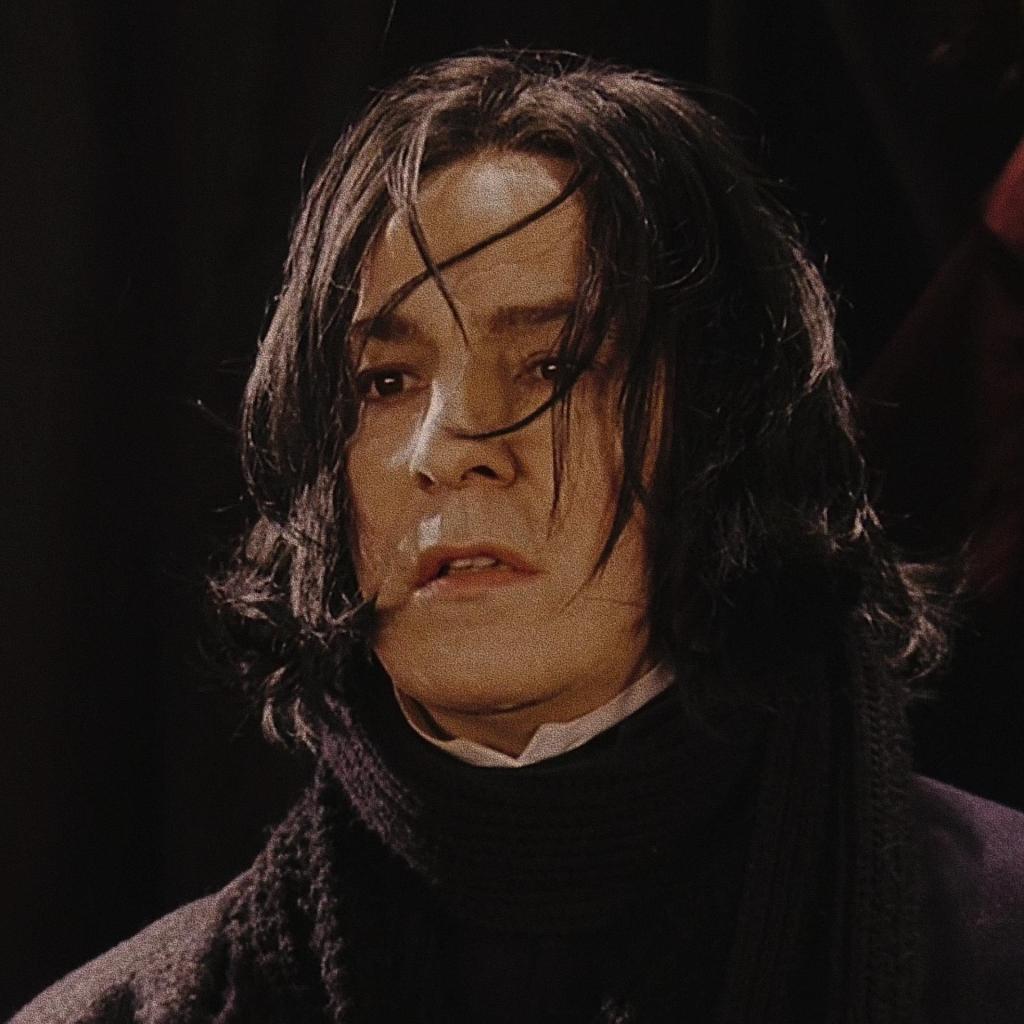
The shapeshifter can take different forms:
- Someone you thought to be an ally who turns out to be either an agent of the shadow or the villain himself. Someone like this is good to provide one final challenge if things are going too easily. This character puts yet another obstacle in the path of our hero.
- In Frozen, we believe the character of Hans to be heroic, and the true love of Anna. But when the crucial moment arrives, he betrays the sisters, and acts on his true motive when he attempts to usurp the throne of Arendelle.
- The exact opposite: an agent of the shadow who turns out to be an undercover ally who assists the hero at an opportune time. This character is a good way to give the hero a second life if all is hopeless.
- Throughout the Harry Potter book series, Severus Snape has an adversarial relationship with Harry and his friends; they are certain that he’s an ally of the evil Lord Voldemort. This is confirmed, they think, when Snape kills Professor Dumbledore, Harry’s mentor. However, at his moment of death, Snape is revealed as Harry’s greatest ally when, through a memory, he shows Harry the path to defeating Voldemort.
- A double agent, a character who has been working in his own self- interest but finally chooses a side at the end. Usually, they side with the hero. With characters like these, it’s a good way to illustrate the moral center of the story. If the reader or viewer hasn’t been sure about what they should feel, let the guy who discovered morality for himself show you how he came to believe in goodness
- Some factor might come into play that simply causes a character to switch sides for some reason.
- In Spider-Man: Into the Spiderverse, the villain’s main henchman is a masked baddie nicknamed The Prowler, who has orders to capture and kill the young Spider-Man. When the man who wears the mask realizes that his target is actually his nephew Miles, he declines to follow through on his orders and is killed as a result.
- A character who hasn’t been certain of where they stand themselves; they may have been wavering between two separate beliefs throughout the story. Now is the time they must decide and reveal their true nature, even to themselves.
- In the Lord of the Rings saga, the character of Gollum struggles with himself in his desire to reacquire the ring of power. While it seems that he actually succeeds in conquering his need, in the end he surrenders to it and becomes Frodo’s main rival in the quest to possess the ring.
- Or consider someone else who changes in the opposite direction: in the Amulet series of graphic novels, Prince Trellis is the son of the Elf King, the Villain. He appears at first to be Emily’s enemy, attempting to kidnap the girl to force her to use the amulet’s powers for his own ends. But as we proceed through the story, we see Trellis in contrast to his father and other ruthless elves, and we come to understand that Trellis is a decent person relative to the environment in which he was raised. Trellis is a good example of a character we understand is on their own journey, one towards decency and heroism.
The dramatic purpose of the shapeshifter is to either provide a shock at a desperate moment, or to introduce an air of mystery throughout the story. But by now, we know who they are and what they really want, and their presence must be accounted for by the hero.
What skills, talents, and tools have you acquired that you can use if you find yourself in a showdown with evil? Have you yet made yourself into the hero that can overcome obstacles and achieve your goals?
Superhero Origin Stories

When following the adventures of superheroes, usually the first show / movie / comic is known as the Origin Story. This tells us how the superhero gained his powers and how he came to believe what he believes. The origin story usually follows the hero’s journey model this book covers, but with a twist.
Superhero comics and movies are usually episodic, meaning that they’re intended to just be the first of many stories. The origin story’s purpose is to set up the character for further adventures. The hero is left with a continuing mission at the end, meaning he has just begun.
There are many variations of the origin story, but since it’s an introduction to the character, there are a few things it has to address:
- Who the character was before he obtained his powers. This is the hero’s Ordinary World; he’s just like you and me, with the same goals and concerns in a normal life.
- How he obtained his powers. Sometimes the superhero has always been super, but often an event bestowed upon him some super-abilities, such as flight or super strength. This is the Inciting Incident.
- Daredevil was a normal kid but an industrial accident heightened his senses to an incredible degree.
- Captain America was the subject of an advanced scientific experiment to create a super soldier to fight evil.
- The Flash’s powers were the result of some advanced chemistry and a stray lightning bolt.
- Other heroes, such as Superman, were born with their powers; their Inciting Incident covers how they learned about their special birthright.
- The struggle to master his powers. Just as we must learn to walk, talk, and read, the hero must practice and experiment in order to learn about what he can do, and the extent of his new abilities. In a movie, this is usually accompanied by scenes of him trying and failing, and ultimately learning how to do the new things that only he can do.
- The Principle. In the course of his initial adventure, the new superhero may have been faced with a choice, one that forced him to determine what he really believes and how he should proceed to use his powers. This is the Principle that all heroes fight for, but in the case of superheroes, it’s usually an ideal that leads to . . .
- The Mission. In most hero stories, the end of the story results in victory and a new, peaceful life for our hero and his friends. Not so with the superhero. The Principle that he has come to believe in results in a lifelong mission. Usually it’s something like a desire to fight crime or keep the world safe from evil. Since crime and evil will always exist, his mission is open-ended, and the superhero will spend the rest of his life fighting for this principle. This is how an origin story sets up the superhero for a lifetime of episodes, issues, and sequels.
The Origin Story is structured as a normal hero’s journey. In their first adventure, the superhero is dynamic: they change throughout the story, learning about themselves and determining what they believe. But once the origin story has sent them on their way, they become static: they have arrived at who they’ll be for the remainder of the series, and have come to represent the principle they fight for. In this way, the superhero has much in common with serialized characters from other types of adventure fiction, like James Bond or Indiana Jones.
Superhero Origin Stories: Spider-Man
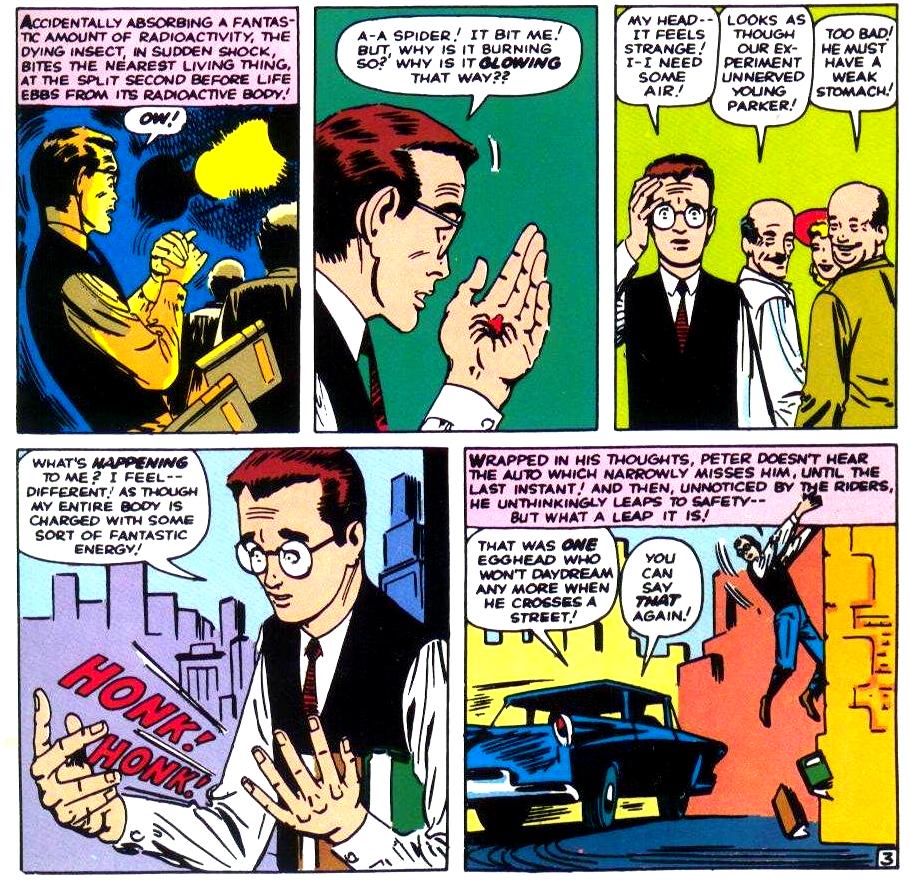
Superhero Origin Stories: Spider-Man
When examining the original Spider-Man, Peter Parker, we find that his origin story is pretty typical. In his Ordinary World, Peter is a normal student, gifted at science and tormented by high school bullies.
In the course of his studies, he attends a research experiment and is bitten by a radioactive spider, giving him his super abilities. This is his Inciting Incident.
Upon discovering his newfound abilities, he works at mastering them and initially uses them simply to make some extra cash. He enters wrestling contests and uses his super-strength and agility to defeat much larger opponents.
One night, he witnesses a robbery, and though he could have easily apprehended the robber, he declines to do so; it’s none of his business. Though he doesn’t know it yet, this was Peter’s Call to Adventure.
Upon returning home, he discovers that his uncle has been killed. Peter captures the killer, only to discover that it’s the same robber that he ignored before. Thus he arrives at the Principle that will guide him forever: “With great power comes great responsibility.” He has been given his lifelong mission.
Spider-Man uses his superpowers to fight crime. What talents and skills do you have, and what are the goals you’ll use those talents to achieve? Just as stories use epic events as stand-ins for the obstacles we face in real life, superhero comics and movies use special powers as stand-ins for the things that we can do, and their ambitious missions represent the goals we set in our own lives.
- Take stock of the skills you have now, how can you use them to achieve your goals?
- Do you have a continuing mission, a lifelong quest to make the world a better place?
- What are your goals? What skills will you need to get there? Better get to work on developing those skills.
The Showdown
At last it’s here: the hero faces his final test against the shadow, a fight with a villain or an evil force. Perhaps it’s the first time he’s encountered this challenge, perhaps not, but it’s definitely the last time. A lot depends on this, nothing less than the future of the world.
Incremental: adjective
one of several successive increases or movements forward.
The weight is increased in precise increments.
This is the final Showdown. The hero is likely (though not always) alone, having lost or been separated from his mentor and allies along the way. This is similar to fighting the “big boss” in a video game; it’s the final challenge. Your character has defeated all the incremental challenges and now it’s time to confront the being or force that represents the most potent example of everything he’s been fighting in earlier levels.
The hero goes willingly into battle; he’s not forced to fight against his will. He knows that this is a task he has to face, whatever the consequences. This is the climax of the story, the most exciting part. A good climax has the potential for victory, defeat, complete destruction, or complete salvation. Any of these outcomes are possible.
Consequence: noun
that which follows; result.
Her stomach pain was a consequence of eating too much.
The hero is now equipped with all of the tools he’s acquired and everything he’s learned. He’s a newer, much more capable person than who he was in the Ordinary World. He has become the best version of himself, and he’ll be put to the test in this last confrontation with evil.
Remember, during the fight, it’s not only the hero that gets tested; his principles are also at stake. The showdown, more than a fight between characters, is really a fight between two different sets of values: those of the hero and of his adversary. Even if the hero doesn’t win, his principles must. That’s where the sacrifice comes in.
The Sacrifice
In many stories, during the showdown, the hero sees a path to victory for his principles, but not for himself. At this moment, he decides to risk death and sacrifice himself for the greater good. This is where the hero truly separates himself from agents of the shadow; a villain would never even consider sacrificing himself for his ideals; his only goal is personal victory. The hero is simply a better person with better beliefs. He fights for principle; agents of the shadow only fight for themselves.
Remember that the conflict between the hero and the shadow happens on three levels. To recap, remember the Three Goals:
- There’s an External Goal, a strategic objective that he must reach in order to achieve victory over The Shadow (the evil forces that oppose him).
- There’s also the Internal Goal, something inside of him that he needs to fix.
- Related to both is the Principle, the ideals and beliefs that he’s really fighting for.
In most stories, winning means achieving all three goals. Those goals are all present in the showdown. Let’s consider some of the stories we’ve been discussing and how the final fight illustrates the hero’s three goals, and how the sacrifice is what really leads to the success of the journey.
Raya and the Last Dragon
Earlier in the chapter on the Hero, we discussed the three goals for Raya. In the final showdown, all of the world’s water disappears, allowing the Druun (the evil force that plagues the land) to attack everywhere with nothing to stop them. Raya realizes that it’s the mistrust between people that allows it to occur.
- The external goal is to defeat the Druun and reunite the land; they need the restored dragon gem to do this, but the individuals who hold the pieces don’t trust one another, and it seems unlikely that they’ll overcome it.
- Raya doesn’t trust Namaari, her main rival throughout the story. Her personal cynicism about people was born in the moment Namaari and Chief Virana tried to seize the gem in the beginning of the movie, and it remains still. Like the people as a whole, Raya doesn’t trust anyone. Overcoming that suspicion is her internal goal.
- The principle of trust and unity drives the whole showdown. If they learn to trust each other, victory is possible; without it, they’re doomed.
Raya realizes the dream of her father and achieves all three goals with her sacrifice. Knowing that Namaari’s distrust is too great for her to surrender her gem piece, Raya instead decides to be the one to extend an olive branch, and she gives Namaari the fragments that she has, fully knowing that she’ll then be petrified by the Druun. By exhibiting trust in her main rival, Raya reestablishes trust among all the people of Kumandra, potentially uniting the land.
Frozen
As we watch the showdown, things for the sisters are . . . not good. Elsa, convinced that she’s responsible for everything bad happening in the world, is fleeing her kingdom of Arendelle, while Anna is being frozen from the inside, a condition that only an act of true love can cure.
- Anna’s external goal is to convince her sister to return to Arendelle and free the town from the permanent winter that Elsa placed on it when she lost control of her powers.
- Her internal goal is to break down the barriers her sister keeps building between them and restore their relationship.
- The principle of sisterly love is at the heart of the story; the importance of it, and how destructive the lack of it can be.
Hans, the opportunistic conman, is about to get everything he wants – if Anna dies, all he has to do is kill Elsa and the throne of Arendelle is his. Anna makes the ultimate sacrifice by putting herself between Hans and Elsa just at the moment when the ice consumes her, preventing him from killing her sister, an act of true love.
Harry Potter
Through seven books (and eight movies), Harry has evaded Voldemort’s attempts to kill him and learned everything he could about how to defeat Voldemort.
- Simply put, Harry’s external goal is to kill Voldemort and end the threat he poses to the freedom and well-being of everyone in the world.
- Harry has always been a good person, but his internal goal is to hone himself and his skills to perfection in order to complete his task; after all, Voldemort may be the most gifted sorcerer who ever lived.
- The competing principles are ones we regularly face on a large scale in our real world: the opposing ideals of peace and freedom versus the desire of some to dominate and control everyone and everything.
In the final showdown, Harry discovers that a piece of the Dark Lord lives inside of his body, and in order to truly defeat Voldemort, he has to sacrifice himself. The separation between the two enemies couldn’t be clearer now: Harry gives himself willingly to death, while Voldemort’s plan all along is to ensure he lives forever. Harry is courage personified, while the emotion that drives Voldemort is fear.
The sacrifice is when the main character fulfills his destiny and becomes the best version of himself; in giving himself up for principle, he has finally become truly heroic. But there’s some good news: he doesn’t die.
For different reasons that depend on the individual circumstances in each story, the hero survives. The important thing is that he was willing to die for the greater good, something the villain couldn’t understand, and would never even consider.
“I should have died — I didn’t defend myself! I meant to let him kill me!”
“And that,” said Dumbledore, “will, I think, have made all the difference.”
– From Harry Potter 7 – Harry Potter and the Deathly Hallows
The sacrifice has purified the hero: any doubts he ever had about the mission or about the principles he defends have been dispelled. He is whole, and fully committed to his rediscovered ideals. Now, he is ready to win.
As stated throughout the book, the hero needed to face the villain alone. But now that he’s made the sacrifice, it’s okay if one of his allies that he was separated from returns to assist him in the endgame. It’s still the hero who has to carry the burden of defeating evil, but he can have some help at this point.
This is a common way to restore an ally after they disappointed us by abandoning the hero earlier. In Moana, Maui left due to a lack of confidence in his own abilities and doubt in the possibility of mission success. But he returns in the nick of time, just as Moana realizes that the lava monster Te Ka is actually the goddess Te Fiti; she only needs Moana to restore her heart to return to her natural form. Maui provides assistance, but it’s still Moana who puts herself in mortal danger by approaching Te Ka to save the goddess.
This is almost exactly what happens in the favorite movie of my childhood, Star Wars. On the eve of the rebellion’s attack on the massive Death Star battle station, the hero Luke Skywalker is abandoned by his ally Han Solo. Like Maui, Han returns to help Luke in a moment of certain death, clearing the way for the young hero to destroy the Death Star.
Victory!
The hero now faces down evil at no disadvantage. She has passed all of the tests and barriers that have been placed in front of her, she has learned all that the mentor and the world has taught her, and she is in full control of all the tools she has. She goes into battle fully prepared.
Remember, the showdown is as much a battle between two principles as it is between two characters (or a character and an evil force). For this reason, the hero cannot violate her principles during the showdown. For instance, in Avatar: The Last Airbender, the hero Ang finally faces the Fire Lord, the ruthless power-mad maniac. During their final showdown, Ang has an opportunity to kill his enemy, but he refuses to, even understanding that the Fire Lord has brought death and destruction to the world. Ang’s principles are peaceful; he fights reluctantly, and vengeance runs counter to his ideals. His behavior during the showdown is crucial in promoting the principles he fights for.
Ultimately, the hero defeats the shadow, and the world is saved (hooray!). She is reunited with her friends and allies, and sometimes even the mentor is reincarnated and rescued from death. Our hero has obtained the wisdom that could make her a mentor to a future hero someday (perhaps in a sequel), but for now, she gets to return home.
Homecoming: A Hero’s Welcome
In traditional mythology, the journey home was considered an equal to the other parts of the story (Ordinary World, Into the Unknown, Into the Villain’s Lair). In modern storytelling, the journey home is usually shortened into its most important element, be it a hearty congratulations from the people of his hometown, a reunion with a loved one, or simply quiet reflection by the hero of the adventure he had.
Once the hero completes his journey, the homecoming is simply an acknowledgement by others of his success. The hero enjoys the acclaim he has earned, and we get to enjoy it with him; his road has led him home again.
What Did We Experience?
Think about the stories you read and watch, and why you like them (or don’t). What do stories do for us?
One thing they do is allow us to have experiences in situations we’re unlikely to encounter in our lives. I can’t speak to what your life is like, but as for me, I seriously doubt that I’ll be recruited to be the next Ultraman with the expectation of protecting Earth from hordes of evil aliens. We get to enjoy the thrills of living a certain life without the dangerous part of it.
However, if you remove the fantastical elements of many of these stories, the more personal parts of them do relate to our lives. Even if you’re not tasked with trekking across orc-infested lands to destroy a magical ring, as Frodo is in Lord of the Rings, you can understand the feeling of working together with friends toward a common goal, such as when you’re on a sports team or creating a project together. No matter how fantastical it is, the friendships in a story are things that can compare to our own experiences, even if we don’t have a dark wizard attempting to kill us and take over the world at the same time.


Leave a reply to Part 2: Into the Unknown – Adventure! Cancel reply